Picking a Humidifier for a Dry Home Office in 2026
Under 30% relative humidity means static, dry sinuses, and cracked wood. Compare the three technologies and their real upkeep cost.
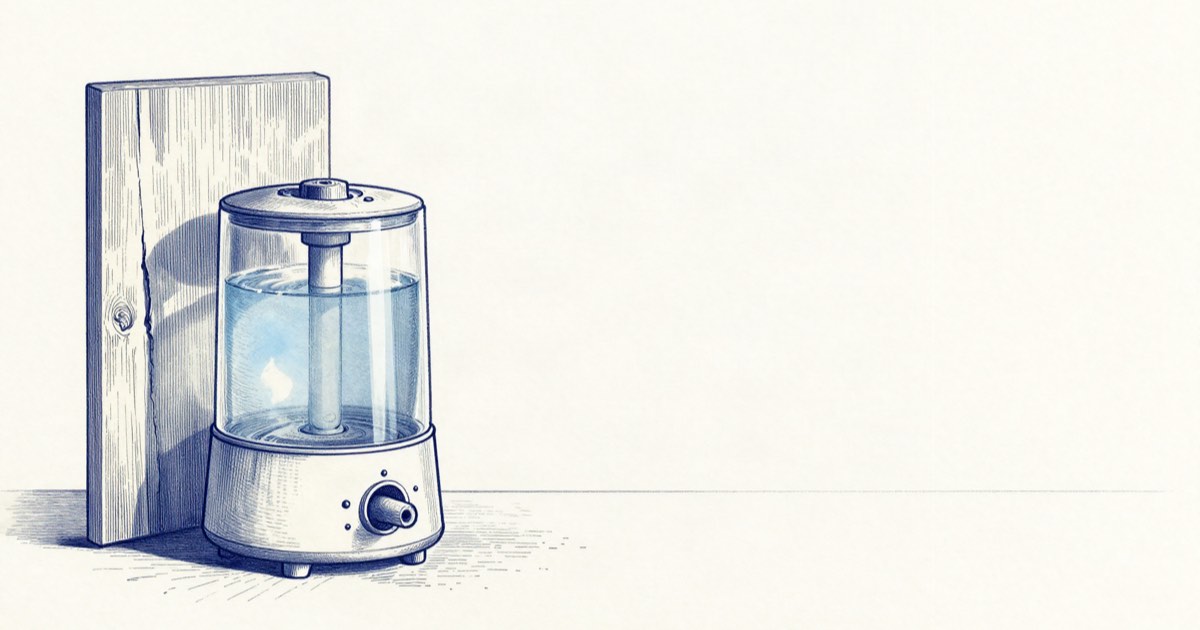
Your office gets dry in winter for a boring physical reason: heating air raises how much water vapor it could hold without adding any. Take outdoor air at 0°C and 80% relative humidity, bring it inside, warm it to 21°C, and it lands near 20% RH before anything else in the room happens. Nothing is broken. The air is just doing what warm air does.
That matters for a room full of electronics and a person who talks on calls for six hours a day. It also means the fix is narrow: add water, or reduce how fast outside air replaces inside air. Most people can only do the first one.
Measure for a week before you buy anything
A hygrometer costs about the same as lunch. Buy two, put one at desk height near where you sit and one across the room, and log readings for a week alongside the outdoor temperature. You are looking for the shape of the problem, not a single number.
The target band is 30–50% RH — the range the EPA and most indoor-air guidance converge on. Under 30%, mucous membranes dry out, wood shrinks, and static discharge gets aggressive: standard ESD references put a carpet walk at roughly 15 kV of body charge in 10–20% RH air, versus well under 1.5 kV above 65%. Your laptop will survive that. An open PCB, a keyboard mid-switch-swap, or a bare drive on the desk sometimes will not. Over 60%, you trade static for dust mites and mold.
The week of logging tells you three things a product page cannot: how far below 30% you actually sit, whether the problem is all-day or only after the heating kicks on, and how fast the number falls back after you leave a door open. That last one is your air exchange rate, and it drives everything about sizing.
Three technologies, three distinct failure modes
Almost every unit you can buy is one of three designs, and each one fails in its own characteristic way.
| Type | How it works | Typical draw | Main failure mode |
|---|---|---|---|
| Evaporative | Fan pulls air through a wet wick | 20–40 W | Wick filters need replacing every 1–3 months; fan noise on calls |
| Ultrasonic | Piezo disc atomizes water at ~1.7 MHz | 25–40 W | Aerosolizes whatever is in the tank — minerals and microbes alike |
| Steam / warm mist | Boils water, releases sterile vapor | 200–400 W | Scale on the heating element; hot water in a room with a chair in it |
| Console / whole-floor | Large-tank evaporative, 1–3 gal/day | 40–80 W | Footprint and refill labor; too much for a single small room |
Evaporative units are self-limiting. A wick can only give up moisture as fast as the surrounding air will accept it, so as the room approaches saturation the output naturally tapers. You cannot easily flood a room with one. The cost is a fan running at 35–45 dBA even on low, which a decent microphone will pick up.
Ultrasonic units are the quiet ones, and that is why they sell. The tradeoff is that they do not distinguish between water and what is dissolved in it. Hard tap water leaves fine white mineral dust on every surface within a couple of meters — including keyboard switches and monitor coatings. The same indifference applies to biology.
Sizing: why the USB desk unit does nothing
Run the numbers for a small office, 30 m³, at 21°C. Saturated air at that temperature holds roughly 18.3 g of water per cubic meter. Moving from 25% to 45% RH means adding about 3.7 g/m³, or around 110 g of water total. That sounds like a coffee cup, and if the room were sealed, it would be.
It is not sealed. At a modest 0.5 air changes per hour, you replace half the room’s air with dry outdoor air every two hours, so you are re-adding roughly 55 g every hour just to hold position. Then subtract what the drywall, books, carpet, and desk absorb before the air ever sees it. Steady state in a small office usually needs 200–500 mL/hr of real output, and more in a drafty room or an older building.
Now look at the desk units. Most run 100–300 mL/hr from a 0.5 L tank — under two hours at full tilt, and the mist disperses long before it changes a room average. That is not a defect; it is a personal comfort device with an effective radius of about half a meter. If you want a room at 40%, you need room-scale output and a tank you refill once a day, not three times.
Placement follows from the same logic. Keep the unit off the desk and out of direct line with the screen and keyboard, a meter or two from where you sit, and raised 60–90 cm off the floor so the plume mixes instead of settling. Do not put it against an exterior wall, and do not park the hygrometer next to it unless you enjoy reading a number that means nothing.
Notion
A two-column table with date, outdoor temp, and desk RH is enough to spot whether your humidifier is holding the band or just running. Cheaper than buying a second unit to fix a placement problem.
Free personal plan; paid plans start around $10 per user per month
Affiliate link · We earn a commission at no cost to you.
The upkeep tax decides which one is right
Add three years of consumables before comparing prices. An evaporative unit with wick filters at $15 a piece, swapped twice a heating season, costs more in filters than it did at purchase. Distilled water eliminates white dust and scale entirely, but at roughly $1 per gallon and 400 mL of daily use, that is another $10 or so a month. Demineralization cartridges split the difference and have their own replacement schedule.
Which brings you to the honest selection rule. Once a unit clears the output threshold your room actually needs, the differences between models are smaller than the difference between a clean tank and a neglected one. Buy the design whose maintenance you will genuinely perform: the steam unit if you want sterility without discipline, the evaporative if you want a forgiving humidistat-free device and can live with fan noise, the ultrasonic only if silence matters more than the weekly ten minutes it demands.
FAQ
Do I have to use distilled water?
Is a small USB desk humidifier enough for a home office?
Can a humidifier damage my computer?
Start with a week of measurements and the room-volume math above. Both are free, both are specific to your space, and together they rule out most of what is on the shelf before you spend anything.
Related reading
2026-09-02
The Best Laptop Stands and Docks for a Home Office
Two 4K60 panels use about 25 of Thunderbolt's shared 40 Gbps, and no dock adds a display your chip refuses to drive. Five picks with the math.
2026-06-22
The Best Under-Desk Treadmills for Developers in 2026
How to compare deck size, noise, and speed range -- plus the standing-desk setup that makes walking while working sustainable.
2026-06-22
The Best Standing Desks for Developers in 2026
Stability, height range, and depth: the specs that quietly ruin a desk for long coding sessions, and how to check them.
2026-06-22
The Best Blue-Light Glasses for Developers in 2026
An honest look at what the evidence says these glasses do for eye strain, and what reduces it more cheaply.
2026-09-02
The Best Ergonomic Office Chairs for 8-Hour Days
Seat height, seat depth and lumbar range eliminate most chairs before comfort matters. Aeron, Leap V2, Sayl, Branch and Markus, compared on specs and warranty.
Get the best tools, weekly
One email every Friday. No spam, unsubscribe anytime.