What the Robinhood IPO case at the Supreme Court means
The Supreme Court will hear Robinhood's IPO case. Here is what interim data is, why the gap matters, and what to check in a prospectus.
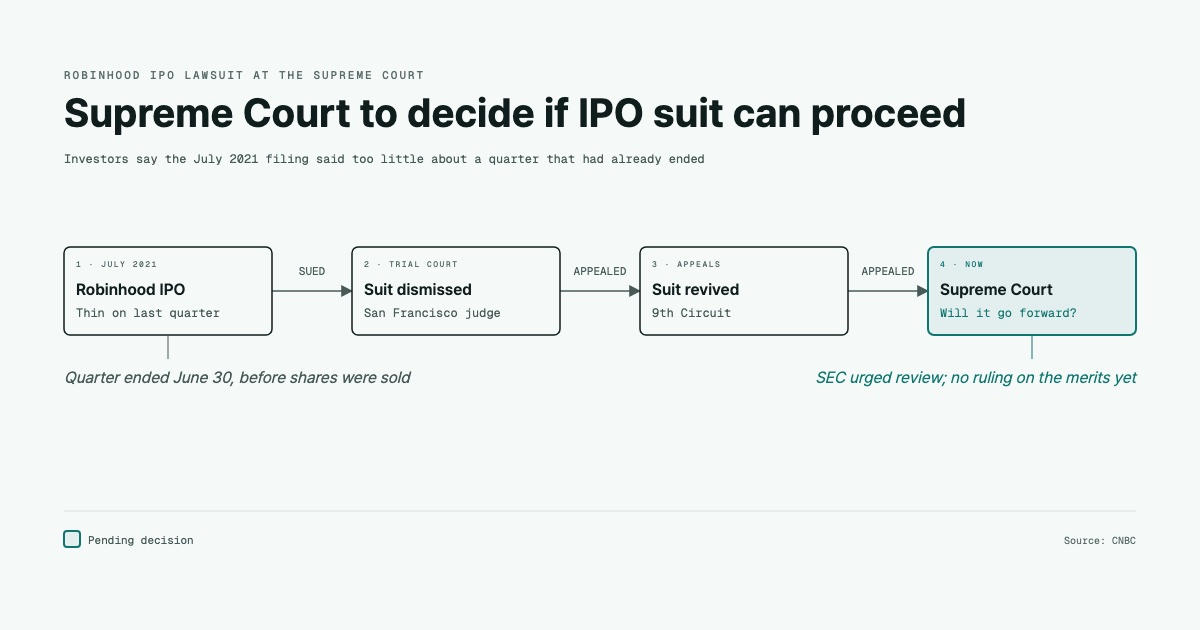
The US Supreme Court has agreed to hear Robinhood’s bid to block a class-action lawsuit over its 2021 initial public offering, according to CNBC. Investors claim the document Robinhood filed before going public in July 2021 left out required information about its second quarter of 2021. That quarter ended on June 30, before the shares were sold. The whole case centers on that gap: how much a company must tell IPO buyers about a quarter that is over but not yet formally reported.
The background you need
A few terms first.
IPO and registration statement. An initial public offering is the first time a company sells shares to the general public. Before it can do that in the US, it files a registration statement with the Securities and Exchange Commission (SEC). The main part of that filing is the prospectus, the long document describing the business, its risks, and its financial results. Think of it as the official sales brochure. The difference is that federal law decides what has to go in it.
Interim financial data. Companies report results by quarter. Interim data means results for a period shorter than a full fiscal year, such as a single quarter. Timing creates a problem. A company can list its shares a few weeks after a quarter closes. It already has a rough idea of how that quarter went, but the audited or reviewed numbers aren’t finished. Many IPO filings handle this with a recent developments section that gives preliminary ranges for the quarter that just ended. How much detail goes there, and when it is required, is exactly the sort of question this lawsuit raises.
Underwriters. Banks that organize an IPO, set the price, and sell the shares to investors. CNBC reports that the defendants include the firms involved in the offering, among them Goldman Sachs and J.P. Morgan Securities. Including underwriters is common. Federal securities law can hold the banks that sell an offering responsible for what the offering documents say.
How IPO lawsuits usually work. US securities law gives IPO buyers a special right to sue when a registration statement contains a material misstatement or leaves out a material fact it was required to include. Material means roughly this: a reasonable investor would consider the information important. These claims are generally easier to bring than ordinary fraud claims, because investors usually don’t have to prove the company meant to mislead anyone. CNBC’s report does not name the specific statute or disclosure rule the plaintiffs rely on, so treat this as the general landscape, not a description of the exact claims here.
Class action. One lawsuit brought on behalf of a whole group, here investors who bought in the IPO, rather than each person suing alone.
How a case gets to the Supreme Court. The Court picks most of its cases. A losing party asks for review, and the justices agree to hear only a small share of those requests. Agreeing to hear a case is not a ruling. It means the Court thinks the legal question deserves its attention.
An analogy: you sell a used car in early July. You hand the buyer detailed service records through March. You mention only briefly how the car ran in April, May, and June, even though you know. A month later the buyer learns about those three months and is unhappy. Did you have a duty to say more? The analogy breaks in one key way. In securities law the question is usually not general fairness. It is whether a specific disclosure rule required that information and whether it was material. That is a narrower, more technical test.
What actually changed
Here is the sequence, according to CNBC:
- Already true: Robinhood went public in July 2021. Interest in meme stocks and dogecoin trading had surged during the Covid-19 pandemic. The 9th Circuit Court of Appeals described the registration statement as one that “contained only limited information about Robinhood’s performance during the second quarter of 2021.”
- Already true: Robinhood later reported its second-quarter results, and its stock price fell. The 9th Circuit panel described this sequence. That is not the same as a finding that the results caused the drop.
- Already true: A federal judge in San Francisco dismissed the investors’ lawsuit. The 9th Circuit then revived it.
- New: On Friday, the Supreme Court agreed to hear Robinhood’s appeal of the 9th Circuit’s ruling. CNBC reports that the Trump administration and the SEC had urged the Court to take the case.
What has not changed: no court has decided whether Robinhood’s filing actually broke the rules. The fight so far is over whether the lawsuit can proceed at all.
What it means for developers who invest on the side
The lever is the omitted quarter. You will see this pattern again. A company lists shortly after a quarter closes, and the prospectus says little about that quarter. The Supreme Court is now positioned to shape how much legal protection IPO buyers have in that situation.
There are two broad ways this could go. These are scenarios, not predictions:
- If the Court sides with Robinhood, suits that rely on thin disclosure of a just-finished quarter could become harder to bring. That would shift more of the burden onto you to notice the gap before you buy.
- If the Court sides with the investors, companies and their underwriters would have more legal reason to disclose detail about recently closed quarters. Prospectuses might then carry more of that information.
The SEC’s involvement matters. The SEC writes and enforces the disclosure rules for registration statements. When the regulator asks the Court to hear a disclosure case, that suggests the question reaches beyond one company. CNBC does not say what position the SEC took on the merits or why it wanted review. Don’t assume either.
If you hold Robinhood shares, a pending class action is a possible liability, not a settled cost. Companies typically describe ongoing litigation in the legal proceedings section of their annual and quarterly reports. That is where to look for how Robinhood itself characterizes the case.
What to watch next: the written briefs, which will state the exact legal question, and the oral argument.
What we don’t know yet
- The precise legal question. CNBC does not spell out which disclosure rule is in dispute or what standard the Court will apply.
- The plaintiffs’ side. CNBC says it requested comment from the plaintiffs’ attorneys. Their response was not in the report.
- Why the SEC and the administration backed review. The report says they urged the Court to hear the case, not what outcome they favor.
- Damages. The report does not say how much the investors are seeking.
- Timing. The report gives no date for argument or a decision.
- Cause of the stock drop. The 9th Circuit described the drop as coming after the second-quarter results. Whether those results caused it is a separate question.
Robinhood’s only public comment so far, per CNBC, is that it is pleased the Court took the case and looks forward to arguing it.
FAQ
Does the Supreme Court taking the case mean Robinhood will win?
What is interim financial data in an IPO?
Does this affect me if I never bought Robinhood's IPO?
Related reading
2026-11-15
What the Fed's AI risk survey means for investors
87% of Fed survey respondents now name AI as a top financial risk, up from 50% in spring. Here's what that number measures, and what it doesn't.
2026-11-14
What ChatGPT Wallet means for OpenAI's revenue
OpenAI's agents can now pay with your card, but OpenAI takes no cut yet. Here is how the payment plumbing works and what to watch.
2026-11-08
What Berkshire's $9.6B Q3 buyback jump means
Berkshire more than doubled its buybacks while operating profit fell. Here is how its repurchase rule works and which numbers in its report to read first.
2026-11-06
What CoreWeave's 16% bond yield says about AI debt
CoreWeave's bond yield topped 16% and AI credit insurance costs jumped. Here is what yields and CDS measure, and what to watch next.
2026-10-30
Why two Fed dissents for a hike matter to you
The Fed held rates, but two voters wanted a hike. Here is how the vote, the dissents, and Warsh's new meeting schedule fit together.
Get the best tools, weekly
One email every Friday. No spam, unsubscribe anytime.