What ChatGPT Wallet means for OpenAI's revenue
OpenAI's agents can now pay with your card, but OpenAI takes no cut yet. Here is how the payment plumbing works and what to watch.
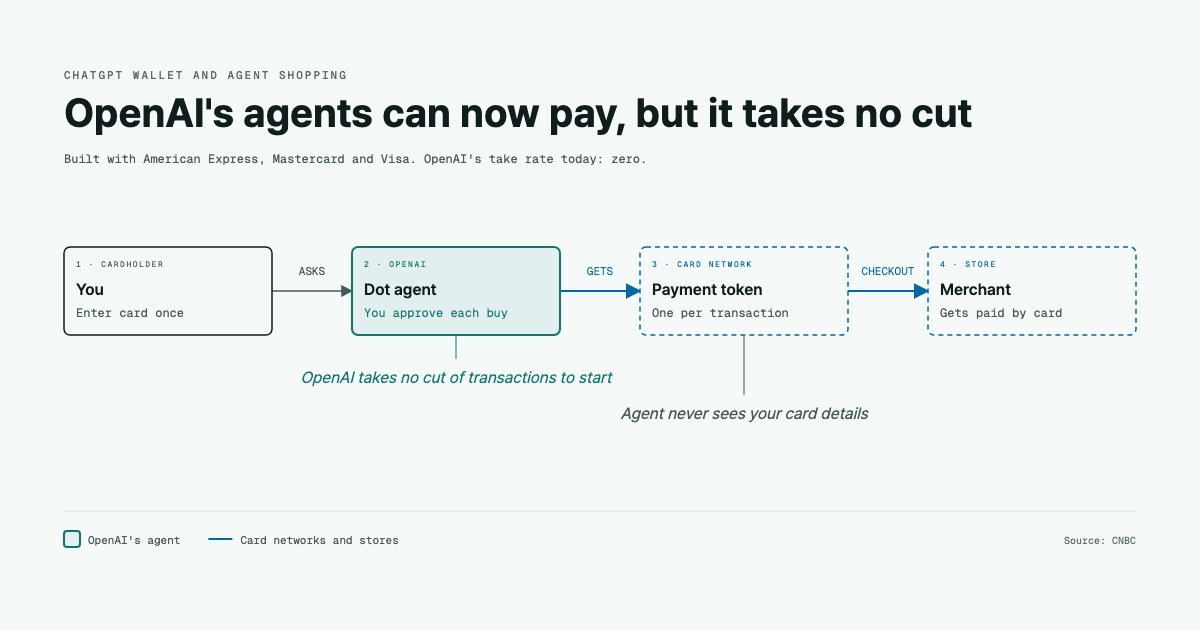
OpenAI announced ChatGPT Wallet on Friday. It is a payment feature that lets the company’s dots AI agents buy things on your behalf, according to CNBC. One detail decides what this means for you as an investor. OpenAI said it is not taking a cut of transactions to start, even though CNBC reports these purchases could eventually kick-start a new revenue stream. So the launch is a bet on future economics, not a source of money today.
The background you need
What a dot is. A dot is OpenAI’s name for a personal AI agent. An agent is software that takes actions for you rather than only answering questions. It might search sites, fill in forms, or book something. According to CNBC, OpenAI introduced dots at its developer conference in late September. That came shortly after Meta’s Muse offering topped the App Store charts.
What agentic commerce is. Agentic commerce is the industry term for agents shopping and paying for people. The hard part is not finding a product. The hard part is letting software spend your money safely, and getting merchants to accept a buyer that isn’t a human clicking buttons.
How a card payment works. When you pay by card, several parties are involved:
- You, the cardholder.
- The issuer, the bank that gave you the card.
- The merchant, the store.
- The network, such as Visa or Mastercard, which routes the transaction between banks. American Express acts as both network and issuer for its own cards.
The merchant pays fees on each card sale. Those fees are split among the parties in the chain. That fee pool is part of what funds card rewards and buyer protections. This matters because any new player in the middle of a purchase, such as OpenAI, would have to earn money from somewhere in that chain or add a new charge on top.
What a payment token is. A token is a stand-in for your real card number. According to CNBC, the networks give the dot a payment token that contains a scoped card number, security code and expiration date specific to a given transaction. OpenAI said its dots will never actually access your card details.
An analogy: a token is like a valet key. It lets someone drive your car without getting the key to your house. The analogy breaks in one place. A valet key works again tomorrow. A transaction-specific token is built for one purchase, so a leaked token is far less useful than a leaked card number.
What a take rate is. Platforms that sit between buyers and sellers often earn a percentage of each transaction. App stores and online marketplaces work this way. Investors call that percentage the take rate. Right now, according to CNBC, OpenAI’s take rate on Wallet purchases is zero.
What actually changed
Some of this was already true before Friday:
- Dots already existed. They launched in late September, according to CNBC.
- OpenAI already helped people find products. CNBC says it rolled out a revamped shopping experience by March to make finding and comparing products easier.
- OpenAI had tried checkout before. CNBC reports it introduced an Instant Checkout feature last fall and quickly pivoted away from it.
Here is what is new, per CNBC:
- Agents can now complete the purchase. Eligible users enter their card information once, ask their dot to find items, and approve each purchase with a security check.
- The card networks are formal partners. OpenAI built Wallet with American Express, Mastercard and Visa. Cardholders keep their existing rewards and protections.
- The rollout is narrow. Wallet is initially available only to Pro subscribers in the U.S. who are over 18. Luke Gebb, who leads innovation at Amex, told CNBC the limited rollout is intentional.
- No cut for OpenAI, for now. The company said it is not taking a share of transactions to start.
- Merchant guidance. OpenAI published tools and guidance for businesses, including how to make sure their sites aren’t inadvertently blocking its agents.
Chaya Nayak, who leads product for monetization and payments at OpenAI, told CNBC that Wallet builds on the company’s earlier product discovery work. It is meant to carry a shopper from finding an item through to buying it.
What it means for developers who invest on the side
The zero take rate is the lever. Everything else in the announcement is plumbing.
With no cut, Wallet produces no direct transaction revenue for OpenAI today. CNBC frames the launch as OpenAI building relationships with merchants and positioning itself as a serious platform for shoppers. Nayak said the people OpenAI is really speaking to are the networks and the merchants. So if you are trying to understand OpenAI’s business, read Wallet as distribution and partnerships, not as a revenue line.
The scale is why the option could matter later. According to CNBC, ChatGPT had more than 1.2 billion weekly active users and nearly 100 million paying users as of the end of the third quarter. Gebb said OpenAI can decide to “turn up the volume” on Wallet when it wants to. Today the feature reaches only the Pro tier in one country.
What to watch next:
- Whether a fee appears, and who pays it. If OpenAI starts charging, it could charge merchants, share in network economics, or charge users. The sources don’t say which. Each would land on different companies.
- Rollout beyond Pro. Expanding to more tiers or countries is the step that would turn a contained test into real volume.
- Merchant resistance. According to CNBC, United Airlines said it will block agents from booking tickets through its systems, and Amazon prevents agents from buying on its platform. An agent that can’t reach the biggest stores has less to offer.
- Card network position. Purchases run on tokens the networks issue, and users keep their card rewards and protections. Agent shopping, as built here, uses existing card rails rather than replacing them.
If you build websites, there is a practical check too. OpenAI’s guidance covers sites that inadvertently block its agents. Review your bot rules and firewall settings, and decide deliberately whether you want agent traffic.
What we don’t know yet
- When or whether OpenAI will take a cut. CNBC says purchases could eventually kick-start a revenue stream, but gives no timeline or rate.
- Who would pay. Merchants, networks, and users are all possible. The sources don’t say.
- Where your card details are stored. CNBC says you enter card information once into Wallet and that the agent never sees your card details. It does not say where those details are held.
- Rollout timing. There is no stated date for reaching non-Pro users or users outside the U.S.
- Adoption numbers. No figures on how many people use Wallet or how much they spend.
- Merchant response. It is unclear whether companies like Amazon or United will change their stance. OpenAI itself calls agentic commerce still in its “early days.”
- Why Instant Checkout was dropped. CNBC says OpenAI quickly pivoted away from it but does not give a reason. Anything beyond that is a guess.
FAQ
Does the AI agent see my credit card number?
Is OpenAI making money from ChatGPT Wallet?
Can I use ChatGPT Wallet now?
Related reading
2026-11-15
What the Fed's AI risk survey means for investors
87% of Fed survey respondents now name AI as a top financial risk, up from 50% in spring. Here's what that number measures, and what it doesn't.
2026-11-14
What the Robinhood IPO case at the Supreme Court means
The Supreme Court will hear Robinhood's IPO case. Here is what interim data is, why the gap matters, and what to check in a prospectus.
2026-11-08
What Berkshire's $9.6B Q3 buyback jump means
Berkshire more than doubled its buybacks while operating profit fell. Here is how its repurchase rule works and which numbers in its report to read first.
2026-11-06
What CoreWeave's 16% bond yield says about AI debt
CoreWeave's bond yield topped 16% and AI credit insurance costs jumped. Here is what yields and CDS measure, and what to watch next.
2026-10-30
Why two Fed dissents for a hike matter to you
The Fed held rates, but two voters wanted a hike. Here is how the vote, the dissents, and Warsh's new meeting schedule fit together.
Get the best tools, weekly
One email every Friday. No spam, unsubscribe anytime.