yt-dlp vs youtube-dl vs pytube (Nov 2026): Stars, Latest Release, Deno Fix
Nov 19, 2026: yt-dlp 208,956 stars, latest 2026.10.26; youtube-dl 141,604, no tagged release since 2021; pytube 13,207, last PyPI release 2023. Plus the Deno/EJS and PO Token fix for YouTube.
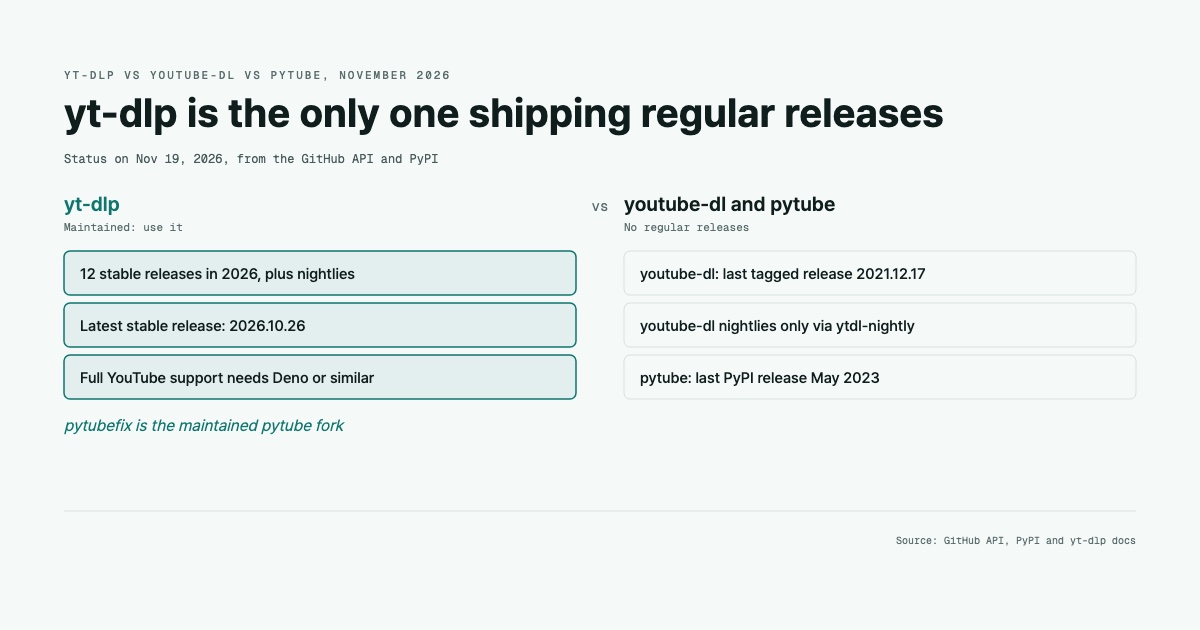
Short answer: use yt-dlp. It is the only one of the three that ships regular releases, and it still works with YouTube in November 2026, provided a JavaScript runtime such as Deno is installed. youtube-dl still receives commits but has not tagged a release since December 2021. pytube’s last PyPI release was in May 2023.
Status on November 19, 2026
| Project | GitHub stars | Latest release | Last commit (default branch) | Maintained? | Recommendation |
|---|---|---|---|---|---|
| yt-dlp/yt-dlp | 208,956 | 2026.10.26 (Oct 26, 2026) | Nov 17, 2026 | Yes: 12 stable releases in 2026, plus nightly builds | Use it |
| ytdl-org/youtube-dl | 141,604 | 2021.12.17 (Dec 16, 2021), on GitHub and PyPI | Nov 6, 2026 | Partly: 6 commits in 2026; newer builds only at ytdl-org/ytdl-nightly (latest 2026.11.06) | Only for legacy Python environments |
| pytube/pytube | 13,207 | 15.0.0 on PyPI (May 7, 2023) | May 20, 2023 | No | Migrate to yt-dlp, or to the pytubefix fork |
| JuanBindez/pytubefix (pytube fork) | 1,658 | 11.2.1 (Oct 16, 2026) | Oct 16, 2026 | Yes | Use it if you want to keep the pytube API |
All figures come from the GitHub REST API and PyPI on November 19, 2026. Stars measure accumulated attention, not maintenance, so read the release and commit columns first. pytube’s repository shows a push in August 2024, but its default branch has had no commits since May 20, 2023. Open issues (excluding pull requests) stand at 3,616 for youtube-dl and 666 for pytube.
To check the numbers yourself:
# Stars, last push and latest release (GitHub CLI)
for r in yt-dlp/yt-dlp ytdl-org/youtube-dl pytube/pytube; do
  gh api "repos/$r" -q '"\(.full_name)  stars=\(.stargazers_count)  pushed=\(.pushed_at)"'
  gh api "repos/$r/releases/latest" -q '"  latest release: \(.tag_name) \(.published_at)"'
done

# Latest version on PyPI
curl -s https://pypi.org/pypi/yt-dlp/json | python3 -c "import json,sys; print(json.load(sys.stdin)['info']['version'])"

# The version you have installed
yt-dlp --version
The latest stable executable is always at https://github.com/yt-dlp/yt-dlp/releases/latest. The 2026.10.26 release raised the minimum Python version to 3.11 and made the official Windows executables require Windows 10 or later.
Does yt-dlp still work with YouTube? What changed in 2025-2026
Yes, but YouTube downloads now depend on two extra components. These are the changes that break older setups, in the order yt-dlp announced them.
1. A JavaScript runtime is required for full YouTube support (since 2025.11.12). YouTube serves JavaScript challenges that yt-dlp must solve. Since release 2025.11.12, yt-dlp solves them by running the yt-dlp-ejs scripts in an external runtime. The announcement calls YouTube support without a runtime “deprecated”: it still works somewhat, but format availability is limited, and the maintainers expect it to get worse. According to the README, when no runtime is available yt-dlp drops the web and tv_samsung clients from its defaults.
Supported runtimes, per the EJS wiki page:
| Runtime | Minimum version | How to enable |
|---|---|---|
| Deno (recommended) | 2.3.0 | Enabled by default |
| Node | 22.0.0 | --js-runtimes node |
| QuickJS / QuickJS-ng | QuickJS 2023-12-9 (versions before 2025-4-26 can take minutes) | --js-runtimes quickjs |
| Bun (deprecated) | 1.2.11 to 1.3.14 only | --js-runtimes bun |
The minimums for Deno, Node and Bun were raised in 2026.06.09. If your Deno or Node predates that release, the runtime can be present but unsupported.
2. The yt-dlp-ejs scripts must match your yt-dlp version. Each yt-dlp version pins one yt-dlp-ejs version and ignores other versions. Whether you already have the scripts depends on how you installed yt-dlp:
| How you installed | What to do |
|---|---|
Official executable (yt-dlp.exe, yt-dlp_macos, yt-dlp_linux, or the yt-dlp zipimport file) | Nothing. yt-dlp-ejs is bundled |
| pip or pipx | Install and upgrade with the default extra: python3 -m pip install -U "yt-dlp[default]" |
| Homebrew | Nothing. The formula for 2026.10.26 depends on deno and includes yt-dlp-ejs |
| Other package managers | Depends on the package. If it lacks yt-dlp-ejs, add --remote-components ejs:github (or ejs:npm with Deno or Bun) |
3. PO Tokens for some clients. YouTube requires a “Proof of Origin” token from some player clients. Without one, the affected format URLs can return HTTP 403, and your account or IP can be blocked (PO Token Guide). yt-dlp cannot generate these tokens itself. By default it uses clients that do not currently need one. If the defaults fail, the wiki suggests the mweb client with a PO Token from a provider plugin such as bgutil-ytdlp-pot-provider. It no longer recommends extracting tokens by hand, because YouTube now binds each token to one video ID.
4. player_client defaults have changed. As of 2026.10.26, the README lists the default clients as tv_samsung,visionos,web. With logged-in cookies, the defaults are tv_samsung,web_embedded,web for free accounts and web_creator,tv_samsung,web for Premium. Copy-pasted overrides from older forum posts, such as player_client=web,web_safari, can now select clients that need PO Tokens. Use default as a base and adjust it, for example --extractor-args "youtube:player_client=default,-web".
Fix checklist when YouTube downloads fail
# 1. Update. Official executables update themselves:
yt-dlp -U
#    pip users: reinstall with the default extra so yt-dlp-ejs is upgraded too
python3 -m pip install -U "yt-dlp[default]"

# 2. Make sure Deno 2.3.0+ is on PATH (or point yt-dlp at it)
deno --version
yt-dlp --js-runtimes "deno:/path/to/deno" URL

# 3. Pace requests (expands to --sleep-requests 0.75 --sleep-interval 10 --max-sleep-interval 20 --sleep-subtitles 5)
yt-dlp -t sleep URL
If the stable release still fails, the README asks you to try the nightly channel (yt-dlp --update-to nightly) before filing a bug. The latest nightly on November 19 was 2026.11.17.232707.
Rate limits: how fast you can safely download
The yt-dlp YouTube extractor wiki states the limits. With default settings, YouTube allows guest sessions about 300 videos per hour (about 1,000 webpage or player requests) and logged-in accounts about 2,000 videos per hour. If you exceed the limit, you get This content isn't available, try again later. The wiki recommends a 5-10 second delay between downloads, through -t sleep or the individual options:
yt-dlp --sleep-requests 1 --sleep-interval 5 --max-sleep-interval 10 --limit-rate 5M URL
--limit-rate caps your own bandwidth. It does not change YouTube’s request limit, so the sleep options matter more. The wiki also warns that using your account with yt-dlp risks a temporary or permanent ban. Use cookies only for content that needs an account (private playlists, age-restricted or members-only videos). Logging in with OAuth no longer works; use cookies instead.
Why yt-dlp replaced youtube-dl
yt-dlp is a fork of youtube-dl, based on the now-inactive youtube-dlc. Features that matter for developer workflows, all documented in its README:
- SponsorBlock integration via
--sponsorblock-markand--sponsorblock-remove - Chapter splitting with
--split-chapters - Concurrent fragment downloads via
-N/--concurrent-fragments - Preset aliases such as
-t mp3,-t mp4and-t sleep - A plugin system for custom extractors, post-processors, PO Token providers and JS challenge providers
- Livestream recording from the beginning with
--live-from-start(experimental; YouTube, Twitch, TVer and mellow-fan)
Most youtube-dl options carry over, but some defaults differ: the default output template is %(title)s [%(id)s].%(ext)s, config file locations change, and some options were removed. The README’s “Differences in default behavior” section lists them. Read it before you swap the binary in an old script. The main reason to keep youtube-dl is Python support: yt-dlp needs Python 3.11+, while youtube-dl still supports Python 2.6+ and 3.2+.
Installation and first run
# Linux/BSD: the zipimport file (needs Python 3.11+ on the host)
curl -L https://github.com/yt-dlp/yt-dlp/releases/latest/download/yt-dlp -o ~/.local/bin/yt-dlp
chmod a+rx ~/.local/bin/yt-dlp

# Linux x86_64 with no Python on the host: the standalone build
curl -L https://github.com/yt-dlp/yt-dlp/releases/latest/download/yt-dlp_linux -o ~/.local/bin/yt-dlp
chmod a+rx ~/.local/bin/yt-dlp

# macOS / Linux with Homebrew (pulls in deno)
brew install yt-dlp

# pip (the [default] extra brings yt-dlp-ejs)
python3 -m pip install -U "yt-dlp[default]"
The plain yt-dlp release file is a zipimport bundle that needs Python. The yt-dlp_linux, yt-dlp_macos and yt-dlp.exe builds are standalone. For a container image without a Python toolchain, use a standalone build and add Deno. A first download:
yt-dlp -f "bestvideo[height<=1080]+bestaudio/best" \
       --merge-output-format mp4 \
       'https://www.youtube.com/watch?v=dQw4w9WgXcQ'
The + joins separate video and audio streams, and --merge-output-format mp4 runs the ffmpeg merge, provided ffmpeg is on your PATH. Use selectors like this rather than numeric format IDs: IDs are whatever the site returns at the moment, and a selector resolves against that list at runtime.
Building pipelines: the Python API
yt-dlp is also a Python library. The option names match the YoutubeDL parameters documented in yt_dlp/YoutubeDL.py:
import yt_dlp
opts = {
'format': 'bestaudio/best',
'outtmpl': 'downloads/%(channel)s/%(upload_date)s_%(id)s.%(ext)s',
'postprocessors': [{
'key': 'FFmpegExtractAudio',
'preferredcodec': 'mp3',
'preferredquality': '192',
}],
'download_archive': 'archive.txt',
'ignoreerrors': True,
}
with yt_dlp.YoutubeDL(opts) as ydl:
ydl.download(['https://www.youtube.com/@somechannel'])
Three options do most of the work in production pipelines:
--download-archive archive.txt records each downloaded video ID in a file. The next run skips anything already in the archive, which is what makes cron-driven channel or playlist mirroring cheap.
-o output template uses Python format-string syntax with metadata fields such as %(channel)s, %(upload_date)s, %(id)s, %(title)s and %(ext)s. Include %(id)s in the path, because titles can collide.
--cookies-from-browser firefox (also brave, chrome, chromium, edge, opera, safari, vivaldi, whale) loads cookies from a local browser profile. On headless servers, pass a cookie file with --cookies cookies.txt. The YouTube wiki explains how to export cookies from a private window so that YouTube does not rotate them.
To collect only metadata and captions, combine --write-info-json --write-subs --sub-langs en --skip-download. The devscripts/cli_to_api.py script in the repository translates CLI switches into YoutubeDL parameters.
Legal and terms of service
yt-dlp can technically download from YouTube, Vimeo, Twitch, SoundCloud and many other sites (the supported-sites list for 2026.10.26 has more than 1,700 extractor entries). Most of those services prohibit downloading in their terms. The defensible cases are archives of your own uploads, Creative Commons content, content explicitly licensed for redistribution, and material you have written permission to mirror. A commercial product built on scraped video invites takedowns and, in some jurisdictions, civil liability. Talk to a lawyer before you ship a training-data pipeline that ingests other people’s video.
For long-running pipelines, pin a stable release and rebuild against the newest stable on a schedule. Keep the pin recent: YouTube fixes arrive through new releases, and yt-dlp prints a warning when the running version is more than 90 days old (--no-update suppresses it).
What we did not test
This page is built from the GitHub and PyPI APIs, yt-dlp’s README, wiki and release notes, and the Homebrew formula. We did not run downloads to measure success rates, speed or rate-limit behavior. The limits quoted above are the yt-dlp maintainers’ figures, not our measurements.
FAQ
What is the latest yt-dlp release?
Does yt-dlp still work with YouTube in 2026?
Do I need a PO Token for yt-dlp?
Is pytube still maintained?
Is youtube-dl dead?
Is yt-dlp safe to use commercially?
Related tools
Some links above are affiliate links. We may earn a commission if you sign up. See our disclosure for details.
Related reading
2026-11-18
Local LLMs on a 16GB M4 Mac: What Fits and What Breaks
A 16GB M4 Mac lets the GPU use about 11.45 GB (macOS 15) or 12.7 GB (macOS 26+). Which 4B-14B models fit at 4-bit, and why 20B+ breaks.
2026-11-18
How Much Mac Memory a 30B or 70B Local Model Needs
Weights plus KV cache must fit the GPU share of unified memory. What 32GB, 48GB, 64GB and 128GB Macs run at 30B and 70B, with the context math.
2026-11-18
Picking an MoE Model for a 24GB Mac with MLX
Total parameters decide whether an MoE model fits in 24GB; active parameters decide speed. File sizes for gpt-oss, Gemma 4, LFM2.5, Qwen and Nemotron.
2026-10-15
What Muse Spark Open's 816B size means for developers
Meta's new open-weight coding model runs like a 42B model but needs the memory of an 816B one. Here's what that means for running it.
2026-10-14
What Anthropic's Scion means for Git and AI coding
Anthropic swapped Git for a custom system called Scion after merges jumped to 30,000 a day. Here is the background and what it means for your workflow.
Get the best tools, weekly
One email every Friday. No spam, unsubscribe anytime.