'Unmetered Intelligence' Moves the Bill, It Doesn't Remove It — Nadella at Build 2026
Microsoft re-ran its founding slogan for the AI era and pushed inference to the edge. The per-token meter does come off — and reappears as hardware you buy up front.
Microsoft’s Build keynote opens with a stack diagram and then immediately goes somewhere more interesting than the stack: down to the edge, where Nadella re-runs the company’s founding slogan with one word changed.
The framing
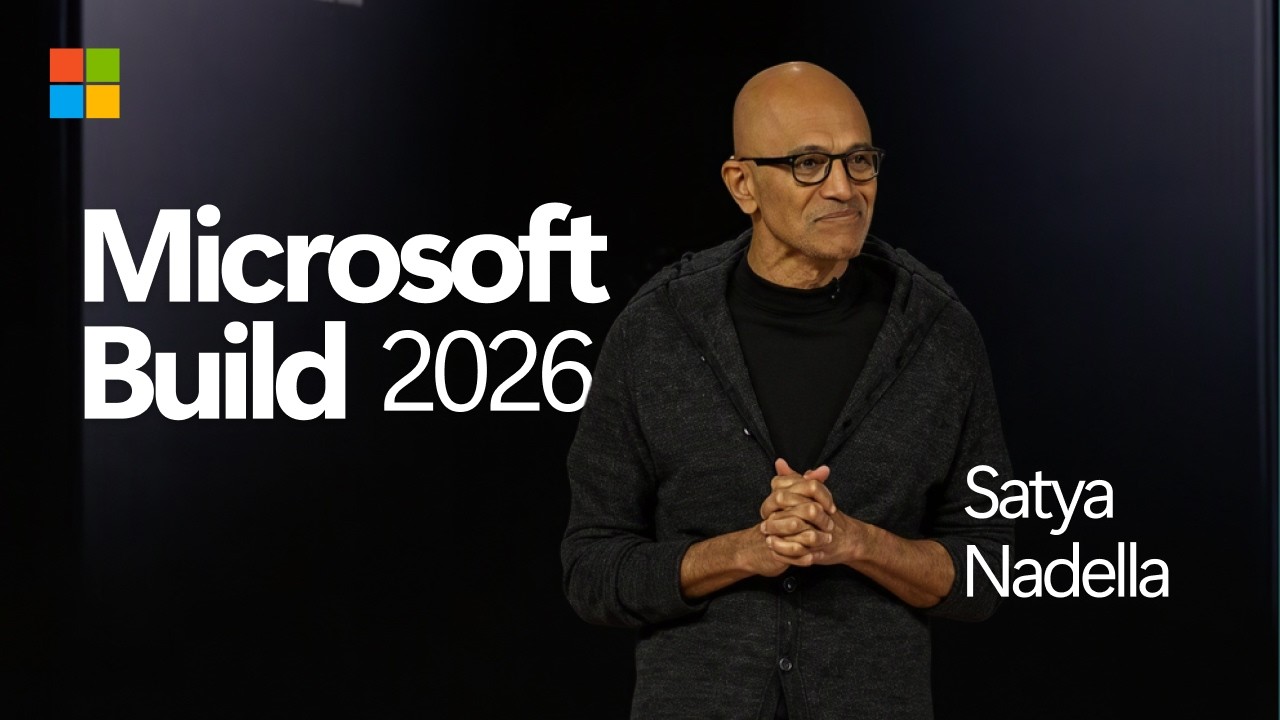
“The amount of compute there is at the edge is actually astounding. I mean, think about every NPU, GPU, CPU even, every PC. If you sort of aggregate that, that’s a lot of compute power. So we asked ourselves one simple question: if we can deliver unmetered intelligence to every desk and every home… It takes us all the way back to the very beginning, but that’s what we said.”
“Every desk and every home” is not an accident. It is Microsoft’s founding mission statement, and invoking it is a claim that local AI inference is the same category of shift as the personal computer itself.
The supporting evidence is that it is already happening quietly. Nadella points at features that already run locally rather than in the cloud — Outlook summarisation, PowerPoint alt text, Teams super resolution — and notes it is not only Microsoft software doing it:
“Adobe After Effects or Premiere are both using Windows ML across NPUs and GPUs for local processing.”
That is the strongest part of the argument, because it is retrospective rather than promised. Local inference already shipped; most users did not notice, which is the correct outcome.
What “unmetered” actually means
Here is where the word does more work than it should.
Per-token billing genuinely disappears when inference runs on the user’s own silicon. What does not disappear is the cost — it moves from a usage-based operating expense to a hardware purchase, made up front, by whoever owns the device.
Nadella is not hiding this — the machines are announced as premium developer hardware, and he jokes about being on the waitlist himself. But the rhetorical move is to let the aggregate install-base argument (“every NPU, GPU, CPU”) carry a conclusion that the flagship demos actually depend on.
The honest version is a spectrum. Small models for summarisation and alt text run on ordinary machines today. Agentic loops with tool access run on good machines. Trillion-parameter models run on a desktop data centre that costs what a desktop data centre costs.
What is real for developers
Three things in the keynote survive the discount.
A local agentic loop is now a supported target. Nadella announces reasoning and planning models running locally on Windows, with the claim that you can “have a full local agentic loop, give it tools access, and build fully agentic applications without having to run a trip to the cloud.” Whatever the model quality, the shape matters: an agent that never leaves the device is a different product from one that does, for latency, offline behaviour, and everything about data handling.
Windows ML is the distribution story. The expansion means one integration reaches the installed base of GPUs and NPUs rather than one vendor’s. For anyone shipping desktop software, that is the difference between local AI being a per-platform project and a single target.
Silicon competition is real at the low end. He notes Qualcomm covering both the high end and sub-$500 PCs, alongside Intel and NVIDIA parts. The sub-$500 tier is the one that decides whether “every desk” is rhetoric or roadmap.
The question to test on your own machine
Before designing anything around local inference, find out what actually fits on the hardware your users have — not the hardware in the demo. Memory bandwidth and available unified memory decide which model sizes are usable, and the gap between “runs” and “runs fast enough that someone will wait for it” is where most local AI plans die.
That is a measurement, not an argument, and it is cheap to do. Pick the smallest model that could plausibly do your task, run it on the lowest-spec machine in your support matrix, and time it. If the answer is acceptable, the keynote’s thesis holds for you and the economics are genuinely better than per-token. If it is not, the cloud bill you were trying to avoid was buying you something after all.
Worth watching
143 minutes, and the opening ten are the thesis. The rest is product, and useful mainly if you are already on Azure or Windows. The reason to watch the opening is not the announcements — it is to see how carefully a compute-cost argument gets built out of an install-base statistic, because you will see the same move made again by everyone selling edge inference this year.
Related reading
2026-09-07
xAI Got Permits for 15 Turbines and Ran 35 — CNBC in Memphis
CNBC's Memphis report is not really about pollution. It is about what happens to an AI buildout when the binding constraint stops being chips and becomes power, permits, and the patience of the people living next to it.
2026-09-07
300 AI Query Optimizations Went In, 30 Came Out — Datadog at DASH 2026
Most of Datadog's two-hour keynote is a product reel. One slide is not: the vendor selling you AI query optimization discloses that 90% of its model's suggestions failed validation.
2026-09-07
Andrew Ng Won't Sign an AI Contract Longer Than a Year — Interrupt 26
Ng's fireside chat at LangChain's Interrupt has one piece of advice with a number attached, and one example that explains why most enterprise AI projects produce a rounding error instead of growth.
2026-09-07
He Renamed One Function and the AI Did More Work — Alexandrescu at ACCU 2026
Andrei Alexandrescu's ACCU keynote argues abstraction survives AI-generated code for an unfashionable reason: not because humans need it, but because throwing it away is inefficient. He has an experiment to show it.
2026-09-04
Every AI Panic Point Has a Precedent. One Doesn't — Mary Shaw at ICSA 2026
Thirty years after co-writing the book that named software architecture, Mary Shaw walks through the field's AI anxieties and shows most of them are re-runs. Then she names the one that isn't.
Get the best tools, weekly
One email every Friday. No spam, unsubscribe anytime.