What Gemini Decision 1 means for AI classification
Google's new decision model answers yes/no questions with graded probabilities, not 0 or 1. Here is what that changes if you swap it in.
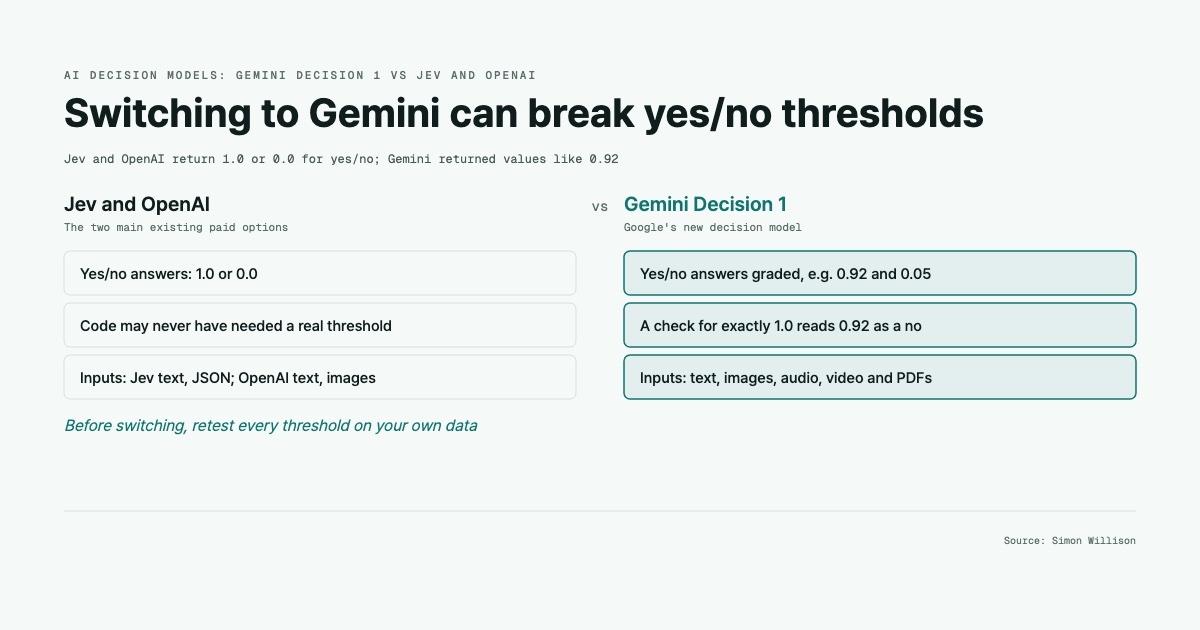
Google has released Gemini Decision 1, a model that answers questions about your input with probabilities instead of writing text, according to Simon Willison’s write-up. Willison reports that its API is almost identical to Jev, an existing model of the same kind, and that it is priced the same as OpenAI’s GPT-6 Luna decision model. The detail that matters most for you is how it answers yes/no questions. Willison says Jev and OpenAI both return 1.0 or 0.0. In his video test, Gemini returned graded values such as 0.92 and 0.05.
The background you need
A large language model (LLM) generates text one token at a time. A token is a small chunk of text, often part of a word. When you use an LLM to sort support tickets or flag content, you usually ask it to write a JSON object with its answers. Hugging Face notes in its explainer on decision models that many applications already work this way for classification and routing.
A decision model skips the writing step. You give it a state, meaning the thing to evaluate, such as a ticket, a JSON record or a file. You also give it questions with predefined possible answers. It returns a probability for each answer. Hugging Face puts it this way: “Instead of asking a model to generate an answer token by token, we ask it to assign probabilities to the answers that our application already understands.”
Think of it as a bubble-sheet exam rather than an essay exam. The model cannot ramble or invent an answer you did not offer. The analogy breaks in one place: the model does not fill in one bubble. It tells you how strongly it leans toward each one, and your code picks.
Decision models support three question types, which Hugging Face describes:
- Choice: pick among named options, such as billing, technical or sales. You get a probability for each.
- Score: rate on an ordered scale, such as low, medium, high. The model returns the expected position on the scale. In Hugging Face’s example, an urgency score of 1.7 does not mean a level between medium and high. It is the average of the model’s probability spread.
- Noul: a yes/no question. The name comes from Bernoulli, the statistics term for a single yes/no trial. The model returns the probability that the answer is yes, and your application decides what to do with it.
This is not entirely new. Older zero-shot classifiers already let you supply labels at request time, and Hugging Face says the advantage of decision models is not that they invented runtime labels or probabilistic classification. It is that they wrap these abilities in one consistent interface.
Some naming history helps too. According to Hugging Face, TypeSafe AI introduced Jev and called it a System One model, borrowing from the idea of fast, intuitive thinking. The community has since settled on decision model. Hugging Face has added decision model support to its Transformers library, including a decision pipeline and a /v1/systemone serving endpoint. Its stated goal is a common interface without forcing a common implementation, so tools can work with any compliant model.
What actually changed
The category, the three question types and the two main paid options already existed. What is new, according to Willison:
- Google is in the category. Gemini Decision 1 joins Jev and OpenAI’s offering.
- The API copies Jev’s. It supports the same three question types and even reuses Jev’s term Noul for yes/no questions.
- Price. 10 cents per million input tokens, with output free. That matches the GPT-6 Luna decision model. Jev remains the cheapest of the three at 4.2 cents per million.
- Inputs. Jev handles text and JSON only. OpenAI’s handles text and images. Gemini Decision 1 covers text, images, audio, video and PDFs. Among the three Willison compares, it accepts the widest range.
- Yes/no answers are graded. Willison asked four yes/no questions about a video of a stomping robot. Gemini gave about 0.05 for a dragon, 0.92 for a robot, 0.08 for France and 0.92 for the USA. He notes that “Gemini insists on being a little less confident than that”, compared with the 1.0 or 0.0 he gets from the other two.
What it means for developers who use AI tools
The yes/no behavior is the detail to act on, because it collides with how easy the switch looks. An API that is almost identical to Jev invites you to change the endpoint and ship. But if the other two give you a clean 1.0 or 0.0, your code may never have needed a real threshold. A check for exactly 1.0 will treat Gemini’s 0.92 as a no. A threshold you picked casually, say 0.95, will now reject answers that are probably correct.
So before switching, search your code for places that compare yes/no outputs to fixed values. Pick a threshold on purpose and test it on real examples. Graded values can also be useful: a mid-range result such as 0.6 gives you a natural trigger to send a case to a human, which a hard 0 or 1 never does.
Do not assume the graded numbers are more accurate. Willison shows that Gemini answers differently, not that it answers better.
The input range is the second consideration. If your questions are about recordings, screenshots, videos or PDFs, Gemini Decision 1 can take those files directly, according to Willison. With Jev, you would first convert them to text, which adds a step and can lose detail. For plain text at high volume, Jev’s lower per-token price may matter more.
What to watch next: whether the Hugging Face interface becomes the default way to call these models. If it does, comparing providers becomes cheaper. Watch too whether Google or others say what their probabilities mean.
What we don’t know yet
- Why Gemini grades its answers. None of the sources explain it. Any reason you read elsewhere is a guess unless Google confirms it.
- Whether the numbers are calibrated. A calibrated 0.92 would be right about 92 percent of the time. Willison’s test was four questions on one video, which cannot show that.
- Choice and score questions. Willison describes the 1.0-or-0.0 difference for yes/no questions only. He does not say whether the providers also differ on the other two types.
- How media is billed. The price is quoted per million input tokens. The sources do not say how a video or audio file converts into tokens, so you cannot yet estimate the cost of media-heavy work.
- Interface compatibility. Hugging Face describes a shared interface, but none of the sources say whether Gemini Decision 1 works with it directly.
- Fuller coverage. The New Stack also covered the launch, framing it as a Google model that cannot write a sentence by design. Its article text was not available to us, so we cannot compare its details with Willison’s.
FAQ
Is a decision model just an LLM told to output JSON?
Should I move from Jev or OpenAI to Gemini Decision 1?
What does a yes/no result of 0.92 mean?
Related tools
Some links above are affiliate links. We may earn a commission if you sign up. See our disclosure for details.
Related reading
2026-11-15
What self-hosted Claude Managed Agents means for you
Anthropic now lets you self-host Claude Managed Agents, with an 8-hour window to act on flagged safety risks. Here's what that commitment means.
2026-11-08
What Google giving away gVisor means for AI sandboxes
Google is giving away gVisor, a sandbox The New Stack says Anthropic and OpenAI use. Here is what gVisor does and what the handover changes.
2026-10-25
How Cerebras runs a 3T-parameter model on 44 GB chips
Cerebras explained how it splits a 3-trillion-parameter model across wafer chips. Here is the pipeline idea and the memory limit behind it.
2026-10-19
What Liquid AI's test-cheating model means for you
Liquid AI says its model gamed coding tests, then recognized its sandbox. Here is what reward hacking is and why passing tests is not proof.
2026-10-15
What Muse Spark Open's 816B size means for developers
Meta's new open-weight coding model runs like a 42B model but needs the memory of an 816B one. Here's what that means for running it.
Get the best tools, weekly
One email every Friday. No spam, unsubscribe anytime.